

Asbestos analysis of a material sample
We find out if the building material contains asbestos. The analysis is done according to the ISO 22262-1 standard with an electron microscope.
Read about the analysis process →Over 100,000 samples analysed
Reliable results from a JEOL electron microscope. Order online, then post your sample or bring it to us - you get the results on the day it arrives.
Electron microscope analysis
The JEOL SEM-EDS electron microscope combines the microscope image with elemental analysis. Any fibre found in the material is assessed on both its structure and its composition.
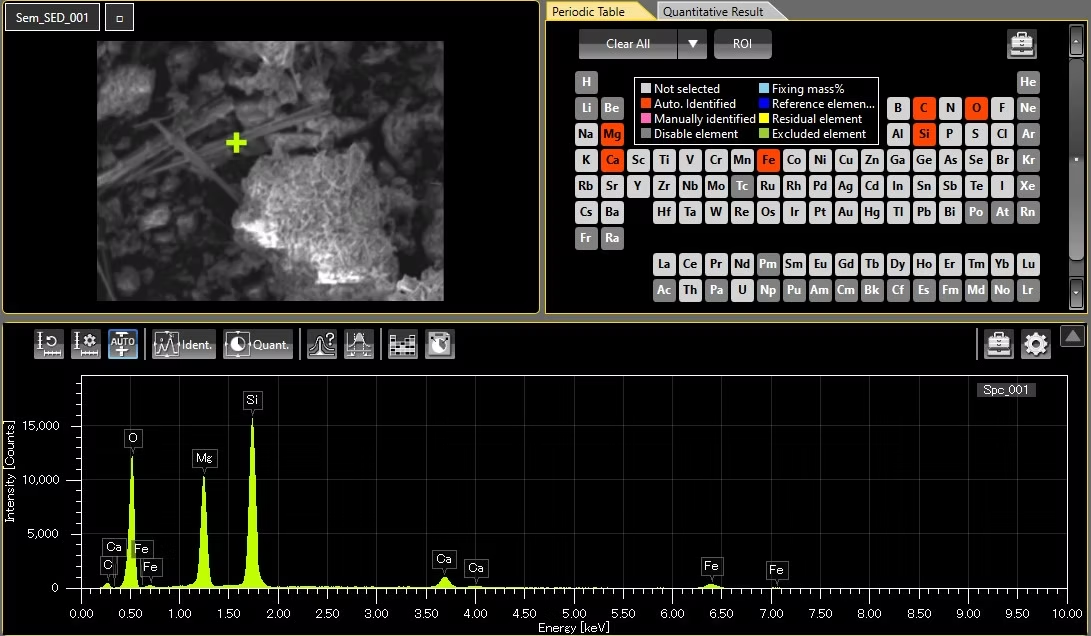
Asbestos analysis is an essential part of every renovation, demolition and repair project in properties built before 1994, because asbestos was used in Finnish building materials well into the 1990s and finding it can completely change a project's schedule and costs. The Onelab laboratory analyses asbestos samples in accordance with the ISO 22262-1 standard using a modern scanning electron microscope whose accuracy is sufficient to identify even very small asbestos fibres inside the material, and you will typically receive the results on the same day that your sample reaches our laboratory by post or courier. An asbestos analysis costs only €39.90 + VAT per sample, with no hidden costs, compulsory add-ons or rush fees, which makes the service equally suitable for private customers facing a renovation, for housing companies during a pipe renovation, for construction companies at the start of a contract and for asbestos surveyors in their daily work. We have designed the whole process to be so simple that anyone can order, send and read an analysis result without any previous experience of asbestos matters or laboratory sampling.
An asbestos sample is taken directly from the building material, and the sampling target can be, for example, vinyl flooring, pipe insulation, a ceiling board, a ceramic tile, mortar, putty, a façade panel, the insulation of an electric cable, a fire insulation board, a door frame seal, the insulation of a ventilation duct or even old floor paint, because asbestos was used in more than two hundred different construction products over several decades right up to the early 1990s, and its use was particularly common in public buildings, schools, hospitals, government offices and blocks of flats. In practice you carefully take a piece of material roughly the size of a matchbox, seal it carefully in an airtight minigrip bag to prevent dust from spreading, and send the bag to us in an ordinary envelope. In our laboratory we analyse the sample with a JEOL SEM-EDS electron microscope, which allows us to reliably distinguish all six of the most common asbestos types from one another: chrysotile or white asbestos, crocidolite or blue asbestos, amosite or brown asbestos, as well as anthophyllite, tremolite and actinolite, each of which requires its own safety and removal measures. The results are delivered to your email as a clear report intended for professional use, and that report is accepted by Finnish authorities, insurance companies, occupational safety inspectors and all contractors in every municipality in Finland, from Helsinki to Rovaniemi.
Why do those who need an asbestos analysis choose Onelab? We have analysed over 100,000 asbestos samples in recent years, and our accumulated experience combined with high-end equipment makes us one of the most trusted asbestos laboratories in Finland, yet our price is still the most affordable in the country, with no hidden costs or compulsory add-ons. Unlike many other laboratories, we do not charge extra for an urgent analysis: we process every sample on the day it arrives, without a separate surcharge or express option. We use a modern JEOL SEM-EDS electron microscope that identifies even small amounts of asbestos fibres, and the LIVE-EDS elemental analysis ensures that optical identification alone does not lead to a wrong result. We also offer air sample analyses for clearance measurements after asbestos removal work and for handing over the site, as well as investigations of harmful substances for PAH compounds, PCB compounds, heavy metals and other substances in building materials that are harmful to health. Our service covers the whole of Finland, from Helsinki, Espoo and Vantaa all the way to Oulu, Tampere, Turku, Jyväskylä, Lahti, Kuopio and Rovaniemi, so same-day analysis results are available no matter which municipality the sample is sent from. Order an asbestos sample on our website in under five minutes.
In-depth guide to asbestos analysis
The Finnish Government Decree on asbestos work (798/2015) requires an asbestos survey before every demolition or repair job in a building constructed before 1994. Amending Decree 886/2025 tightened the rules: the binding limit value of 0.01 fibres/cm³ applies to all asbestos work from 21 December 2025, and from 21 December 2026 fibres in air samples must be counted with an electron microscope. In practice, an asbestos analysis is the only reliable way to establish whether a building material contains asbestos, because a visual assessment is not enough either to identify the fibres or to distinguish asbestos from other mineral wools. Without a valid analysis report a contractor cannot legally start demolition work, and the occupational safety authority can halt the site immediately because of missing documentation. Insurance companies also require an analysis report for damage repairs and moisture damage renovations, and the seller of a property has a duty to inform the buyer of any known asbestos risks. Onelab's report documents the result and asbestos type for every sample. If the site requires an asbestos survey of the whole building, a surveyor's report is needed as well.
Asbestos is not a single substance but a collective name for six different minerals, and each type has different uses, degrees of danger and requirements for removal work, which is why precise typing is just as important as merely confirming that asbestos is present. Chrysotile, or white asbestos, is the most common type of asbestos in Finland and was used in particular in vinyl flooring, roofing boards, pipe insulation and cement products, and although it is less dangerous than the other asbestos types, its fibres still cause lung cancer and mesothelioma after long-term exposure. Crocidolite, or blue asbestos, is the most dangerous type of all because of its thin, hard fibres, and it was used mainly in hot insulation, fire insulation boards and industrial sites. Amosite, or brown asbestos, is often found in pipe insulation and shipbuilding materials. Anthophyllite is a type specific to Finland, because it was mined at the Paakkila mine in Tuusniemi and was used extensively in Finnish building materials such as asbestos mortar. Tremolite and actinolite often occur as impurities among other minerals, and identifying them specifically requires a JEOL SEM-EDS electron microscope instead of an optical microscope.
The most important thing when taking an asbestos sample is to avoid creating dust - detach the sample carefully and use disposable gloves. An FFP3 class respirator is recommended, but not compulsory. From vinyl flooring, a piece of about 5 x 5 cm is taken from a corner or a seam with a knife or a heavy-duty carpet knife, so that any adhesive underneath the flooring is included in the sample. From pipe insulation, a small piece is cut off with scissors or a knife, but note that mineral wool insulation requires a different sampling method than paper-like asbestos insulation. For ceiling boards and wall panels a piece a few centimetres across is enough, and it can be carefully broken off. For mortar samples, a small piece of jointing mortar or surface render is taken, and when investigating ceramic tiles the sample is taken from the tile adhesive behind the tile, not from the ceramic itself. Pack every sample in its own resealable minigrip bag, mark the bag clearly with the sample's material and location, and send the samples to us in an ordinary envelope or a small parcel.
The Onelab analysis report is a PDF file whose first page states unambiguously whether the samples contain asbestos, while the second page describes the method and terms. The results table gives, for each sample, the site, material and location, the asbestos type identified, the dustiness (risk) class 0–5 and the result: contains asbestos, does not contain asbestos or uncertain. The report also includes the customer details, the date the samples were received and how many there were, who took them, the report date and number, the method used (JEOL SEM-EDS electron microscope, ISO 22262-1), an interpretation of the results and the analyst's electronic signature. If there are photos of the samples, they are appended at the end. If no asbestos is found, the report clearly states "Does not contain asbestos", and the material can be handled as ordinary demolition – although the result applies only to the sample analysed. If asbestos is found, the report states the asbestos type and dustiness class, and the removal must be done by an authorised asbestos removal company, which determines the protective measures and waste handling. Keep the report in the building's maintenance file, because you will come back to it in future renovations, property sales and insurance matters.
A positive asbestos finding does not mean that the building is dangerous or that it should be emptied immediately, because in intact building material the asbestos stays in place and does not spread into the indoor air. It becomes dangerous only when the material is broken, sanded, drilled or removed without appropriate protective equipment and working methods, which means that after a positive finding the most important step is to contact a company authorised for asbestos removal work before any repair work begins. The Occupational Safety and Health Department of the Finnish Supervisory Agency maintains a public register of authorised asbestos removal companies, and the task of these companies is to draw up a work plan, submit a notification to the occupational safety authority, carry out the removal work in a sectioned work area under negative pressure and perform a final air measurement that confirms the space is safe. The price range for asbestos removal work is typically €50–200/m² depending on the material and the difficulty of the site, and the cost is always considerably lower than the risk created by illegal removal work or work carried out against the instructions. After the removal work, Onelab offers air sample analyses for clearance inspection, which confirm that no asbestos fibres remain in the space before it is handed back to residents, employees or new users. Also remember that asbestos waste is classified as hazardous waste and that its transport, handling and final disposal must be arranged through a licensed waste management company with a separate consignment note, which an authority may ask to see even years after the removal work.
From sample to report
Enter your contact details and the sample details in the online form.
Pay online, or choose an invoice or a payment link.
Send the samples by post or drop them off at our laboratory yourself.
The samples are logged as received and matched to your order.
Fibres are identified with an electron microscope in line with ISO 22262-1.
A clear result report is delivered on the day the sample arrives.
Enter your contact details and the sample details in the online form.
Pay online, or choose an invoice or a payment link.
Send the samples by post or drop them off at our laboratory yourself.
The samples are logged as received and matched to your order.
Fibres are identified with an electron microscope in line with ISO 22262-1.
A clear result report is delivered on the day the sample arrives.
Enter your contact details and the sample details in the online form.
Pay online, or choose an invoice or a payment link.
Send the samples by post or drop them off at our laboratory yourself.
The samples are logged as received and matched to your order.
Fibres are identified with an electron microscope in line with ISO 22262-1.
A clear result report is delivered on the day the sample arrives.
Why Onelab
The most affordable price in Finland
Asbestos sample analysis only €39.90 + VAT. No hidden costs.
Fast results
Results to your email on the day the sample arrives.
Reliable analysis
A SEM electron microscope and LIVE-EDS, to the ISO 22262-1 standard.
Easy ordering
Order online, send a sample by post. No complicated forms.
Services
We find out if the building material contains asbestos. The analysis is done according to the ISO 22262-1 standard with an electron microscope.
Read about the analysis process →Clearance measurement after asbestos removal work. We confirm that the space is safe to use.
Request an air sample quote →PAH compounds, PCB, heavy metals and other harmful substances in building materials.
Ask about a hazardous substance survey →Popular services
Who we serve
Households
You are renovating and want to find out if the materials contain asbestos.
Housing companies
A pipe renovation, façade renovation or other repair project coming up.
Construction companies
You need a reliable laboratory to analyse asbestos samples.
Asbestos surveyors
You are looking for a fast, affordable laboratory service.
Knowledge base
What does an asbestos analysis mean, how is it done and when is it needed?
Read the full guide →The most common materials and structures where asbestos has been used in Finland.
Read the article →Why you need to find out about asbestos before demolition and how to proceed safely.
Open the renovation guide →Fast, inexpensive and reliable asbestos analysis in the laboratory. Results on the day of arrival.